
You turn off the kitchen faucet, walk away, and hear it. Drip. Drip. Drip.
Maybe it stops after a few seconds. Or maybe it keeps going long after you’ve finished washing the dishes.
A dripping kitchen faucet might not seem like a big deal at first. After all, it’s only a little water. But even a slow drip can waste a surprising amount of water over time. And that constant dripping sound can get pretty annoying.
The good news is that most faucet leaks have a fairly simple explanation. Sometimes it’s a worn-out part, and other times it’s something happening inside the faucet that you can’t see.
If you’ve noticed your kitchen faucet leaking even when it’s turned off, here’s what might be causing it and what you can do about it.
Why Does a Faucet Keep Dripping After You Turn It Off?
Your kitchen faucet has several small parts working together to control the flow of water.
When you turn the handle off, those parts create a seal that stops water from coming through the spout.
Over time, some of those parts can wear down, loosen, or collect mineral deposits. When that happens, the seal may no longer close completely.
Water can slowly make its way past the seal, even though the handle is in the off position.
The cause depends on the type of faucet you have. Some use rubber washers, while others rely on ceramic discs or cartridges. The trick is figuring out which part isn’t doing its job anymore.
6 Common Reasons Your Kitchen Faucet Is Dripping
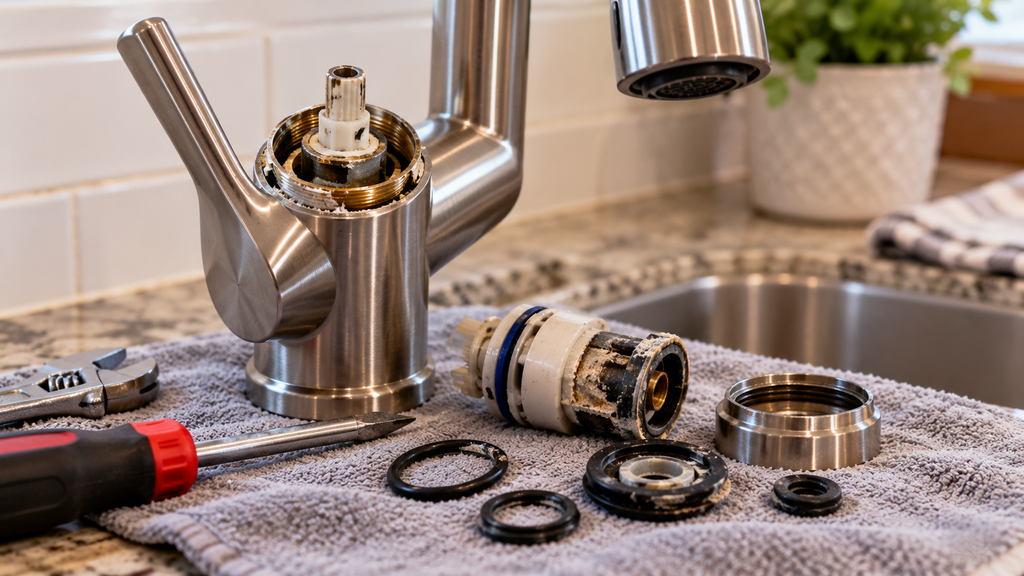
A dripping faucet doesn’t always mean you need a new one. In many cases, replacing a small internal part is enough to get things working properly again.
Here are six common reasons a kitchen faucet might keep dripping.
1. Worn-Out Washers
Some older faucets use rubber washers to help stop water from flowing when the handle is turned off.
Every time you use the faucet, those washers press against a valve seat to create a seal.
After years of use, the rubber can become worn, stiff, or damaged.
Once the washer no longer seals properly, water can slip through and drip from the spout.
Replacing the washer is often a simple repair, provided the other parts are still in good condition.
2. A Damaged Faucet Cartridge
Many modern kitchen faucets use a cartridge to control water flow and temperature.
The cartridge sits inside the faucet body and moves when you adjust the handle.
If the cartridge wears out or becomes damaged, it may not shut off the water completely.
You might notice a steady drip, trouble adjusting the temperature, or a handle that doesn’t move as smoothly as it used to.
A plumber can identify the correct replacement cartridge for your faucet and install it.
3. Worn O-Rings
O-rings are small rubber seals that help keep water where it belongs.
They’re found in different parts of many faucet designs, including around the spout and inside the faucet body.
Over time, these seals can wear out or become brittle.
A damaged O-ring often causes water to leak around the base of the faucet or near the handle rather than from the spout.
If you notice water collecting around the faucet whenever you use it, an O-ring may be the problem.
4. Mineral Buildup Inside the Faucet
Water contains natural minerals that can leave deposits behind as it flows through your plumbing.
Over time, those deposits can collect inside your kitchen faucet.
Mineral buildup may prevent internal parts from closing tightly. It can also affect how smoothly the handle operates.
If your faucet leaking problem started gradually, mineral deposits could be contributing to the issue.
A plumber can inspect the internal parts and determine whether cleaning or replacing them will solve the problem.
5. A Worn Valve Seat
The valve seat is the surface that helps create a watertight seal in certain faucet designs.
When the faucet is turned off, a washer or another sealing part presses against it to stop the water.
If the valve seat becomes worn, corroded, or damaged, water may continue to pass through.
Replacing the washer alone might not solve the problem if the surface underneath it is damaged.
A plumber can check the valve seat and determine whether it can be repaired or if another part needs replacing.
6. High Water Pressure
Water pressure plays an important role in how your plumbing works.
If the pressure in your home is too high, it can put extra strain on faucet seals and other plumbing parts.
Over time, that added pressure may contribute to leaks.
High water pressure can also cause other problems, including noisy pipes and extra wear on appliances.
If several fixtures are showing signs of trouble, your plumber may recommend checking your home’s water pressure.
Is It Normal for a Faucet to Drip After Being Turned Off?
A few drops immediately after shutting off the faucet aren’t always a sign of trouble.
Sometimes a little water remains inside the spout, especially with pull-down or high-arc kitchen faucets.
That leftover water may drip out for a short time before stopping completely.
The difference is whether the dripping stops.
If you hear a few drops and then silence, it may simply be water draining from the spout.
But if the faucet continues dripping several minutes later, there’s a good chance water is getting past an internal seal.
A steady drip is worth checking, even if the faucet still works normally.
How Does a Plumber Find the Cause of a Faucet Leak?
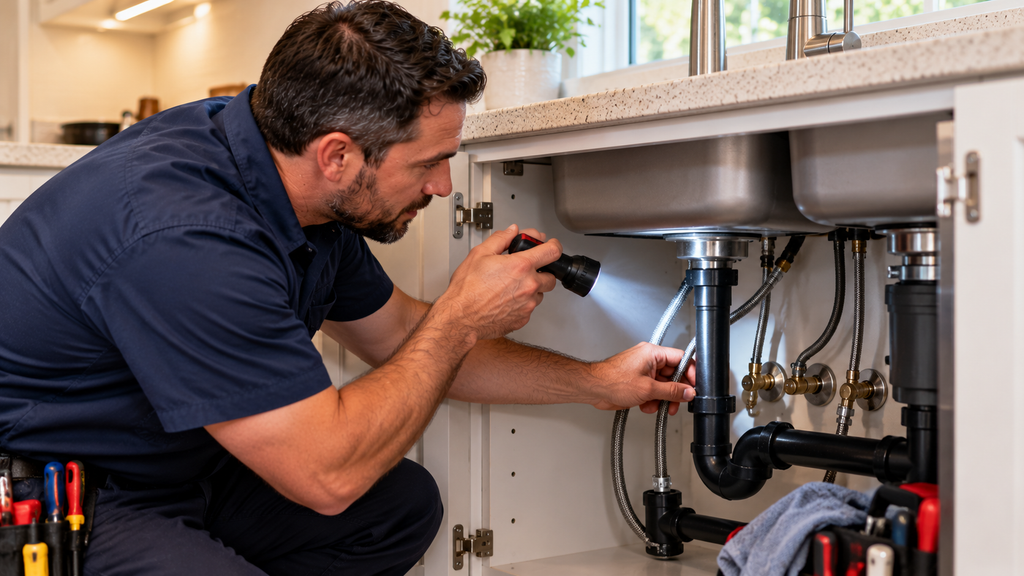
When you call a plumber about a faucet leaking, the first step is figuring out exactly where the water is coming from.
A leak at the spout can have a different cause than water collecting around the handle or underneath the sink.
Your plumber will check the faucet’s condition, look for signs of wear, and identify the type of faucet you have.
They may also inspect the cartridge, washers, seals, or other internal parts.
If the problem appears to involve water pressure, they’ll check that as well.
Once they’ve found the cause, they can explain what needs fixing and whether the repair makes sense.
The goal is to solve the actual problem rather than replace parts that are still working fine.
Should You Repair or Replace a Dripping Kitchen Faucet?
Not every dripping faucet needs to be replaced.
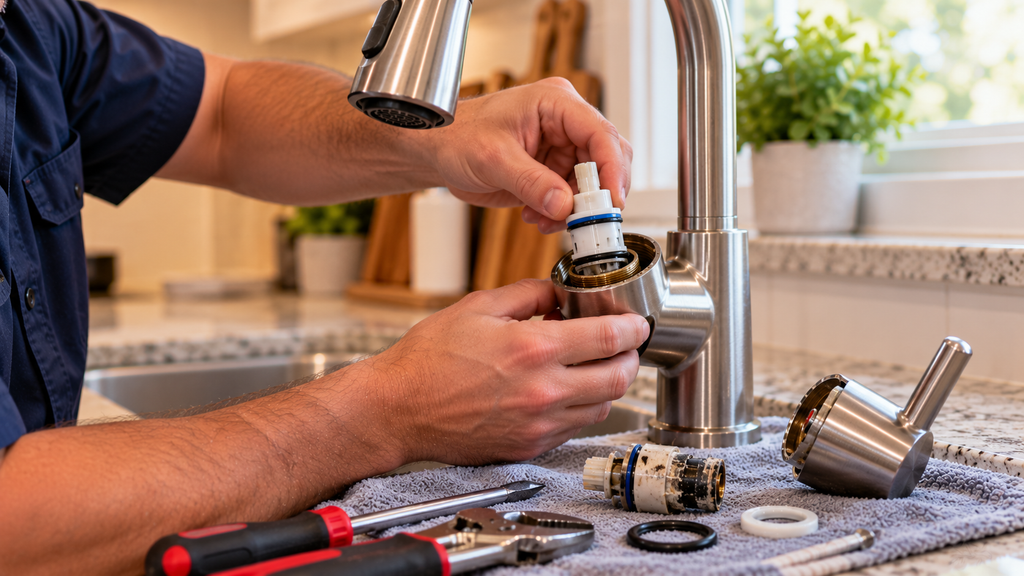
If your faucet is in good shape and the problem comes from a worn washer, seal, or cartridge, repairing it is often the most practical option.
A simple repair can give your faucet several more years of use.
However, replacement may make more sense in some situations.
For example, an older faucet might have several worn parts, corrosion inside the body, or damage that can’t be repaired easily.
Replacement parts may also be difficult to find for certain models.
If you’ve had the same faucet repaired several times, the cost of another repair might be better spent on a new one.
A plumber can help you compare your options without pushing you toward a replacement you don’t need.
Can You Fix a Dripping Kitchen Faucet Yourself?
Some faucet repairs are fairly straightforward, especially if you know the brand and model.
However, different faucets have different internal parts, and getting the right replacement matters.
Before taking anything apart, the water supply needs to be shut off properly.
If a part is installed incorrectly or a connection isn’t sealed, you could end up with a bigger leak.
Water leaking underneath the sink deserves particular attention because it can damage cabinets and flooring.
If you’re unsure which part needs replacing, a professional repair can save time and help prevent further problems.
When Should You Call a Plumber for a Leaking Faucet?
You don’t need to wait until your kitchen faucet develops a major leak before calling for help.
If the dripping continues after the faucet is turned off, it’s worth having it checked.
You should also arrange service if water is collecting around the base, dripping beneath the sink, or affecting nearby cabinets.
A faucet that’s becoming difficult to turn off or showing signs of corrosion may also need attention.
The sooner you find the cause, the easier it often is to prevent water waste and damage.
Need Kitchen Faucet Repair in Abbotsford? TYS Plumbing & Heating Can Help
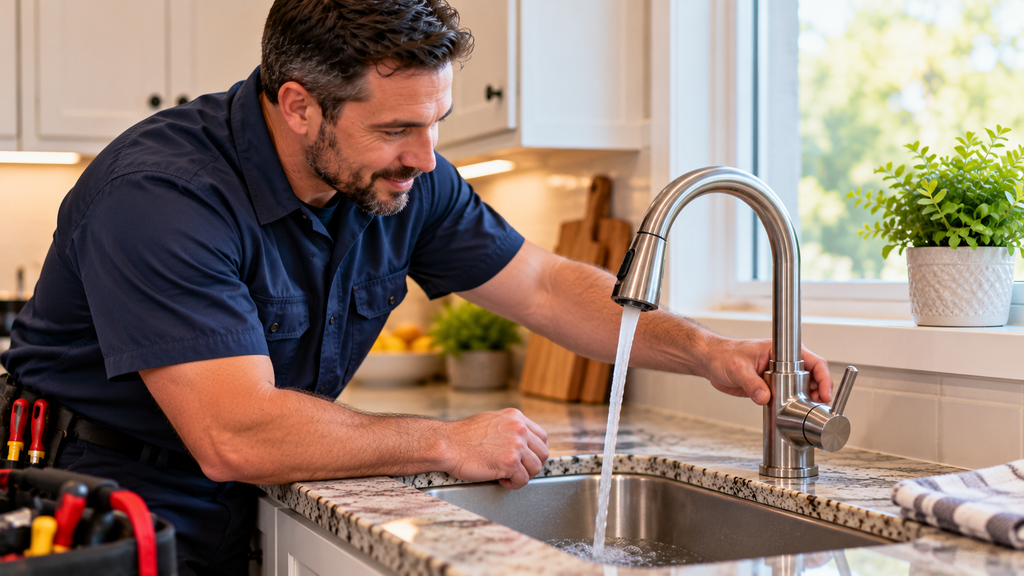
A dripping faucet is one of those little household problems that’s easy to put off. But it doesn’t have to become a bigger headache.
At TYS Plumbing & Heating, we believe in practical solutions, clear explanations, and repairs that make sense for your home.
Whether you’ve got a kitchen faucet leaking from the spout, around the handle, or underneath the sink, we’ll help you find the cause and explain your options.
If a repair will do the job, we’ll let you know. And if replacing the faucet makes more sense, we’ll explain why.
Need faucet repair in Abbotsford or the surrounding area? Contact TYS Plumbing & Heating to book a service appointment. We’ll help get that dripping faucet taken care of.